
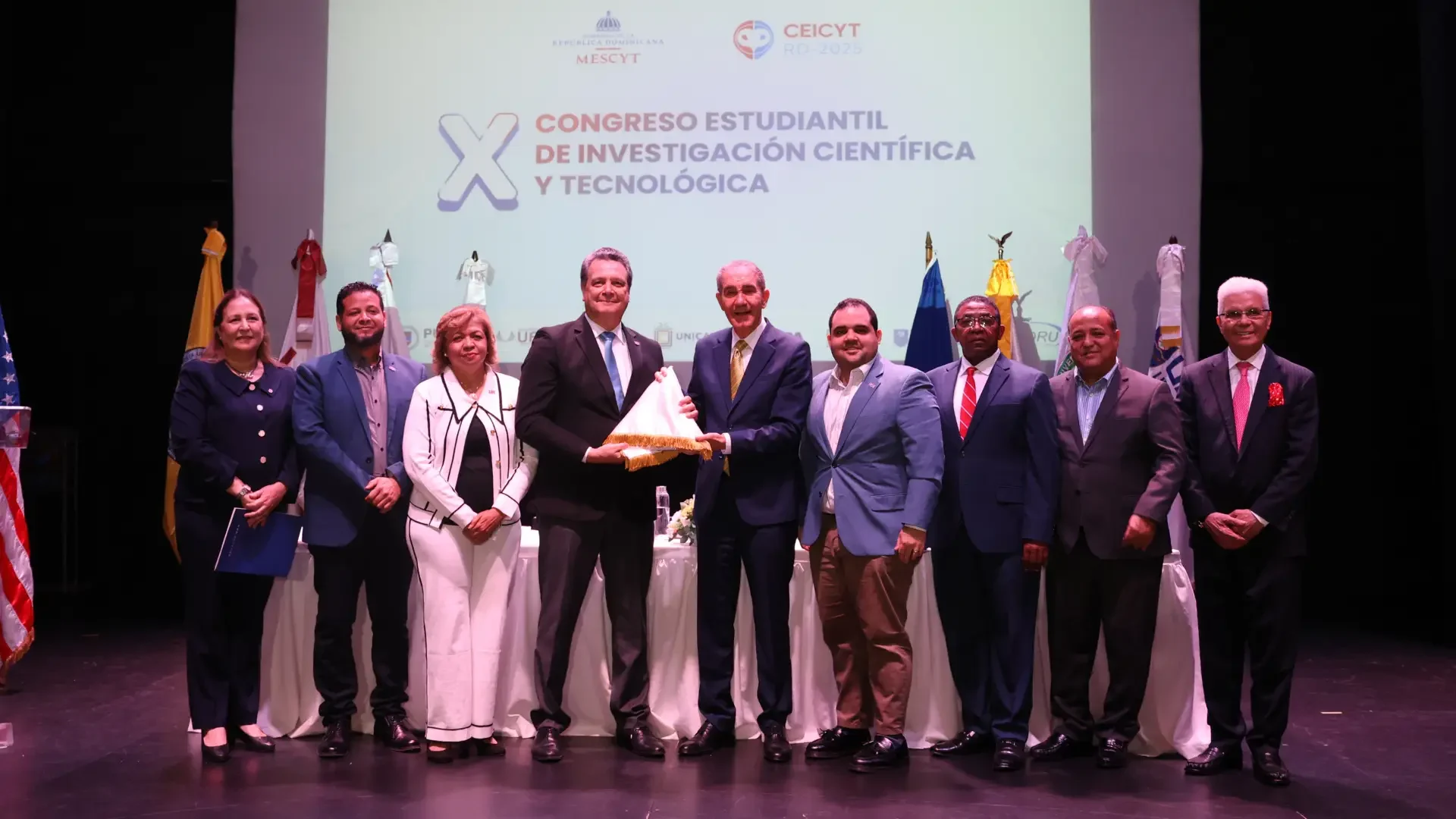
The CEICYT 2025 successfully concludes, and UNICDA is announced as the host of CEICYT 2026
The 10th Student Congress on Scientific and Technological Research (CEICYT 2025) successfully concluded, standing as one of the country’s most important academic events, which each year brings together hundreds of young researchers to present innovative projects across diverse fields of knowledge.
In this edition, held with great participation, 392 research projects were approved, of which 316 were presented orally and 76 in scientific poster format, showcasing the talent, creativity, and research commitment of Dominican university students.
The ceremony began with remarks from UNICDA’s rector, Eng. Ramón Sosa, who emphasized the honor of hosting the awards and the importance of CEICYT in promoting research and innovation. Afterwards, Vice Minister Dr. Genaro Rodríguez Martínez highlighted the value of collaboration among institutions, followed by Dr. Virginia Flores from PUCMM, who reaffirmed her university’s commitment to scientific training. Finally, Minister Dr. Franklin García Fermín expressed MESCyT’s support for the advancement of science and congratulated all participants for their dedication.
As part of the closing ceremony, cash prizes were awarded to recognize academic excellence in each of the seven areas of knowledge:
UNICDA to Host CEICYT 2026
During the closing of the congress, it was officially announced that the Universidad Domínico Americano (UNICDA) will host CEICYT 2026, a recognition that reaffirms its role as an educational benchmark and its commitment to scientific research and inter-university collaboration.
After successfully hosting the 2025 edition, UNICDA once again offers a favorable environment for the presentation, discussion, and strengthening of research projects in areas such as basic sciences, applied sciences, health, agriculture, environment, and more.
This announcement marks a new chapter in the trajectory of the congress promoted by MESCyT, whose purpose is to foster innovation, strengthen scientific culture among young people, and create a space for generating solutions to the country’s social and economic challenges.